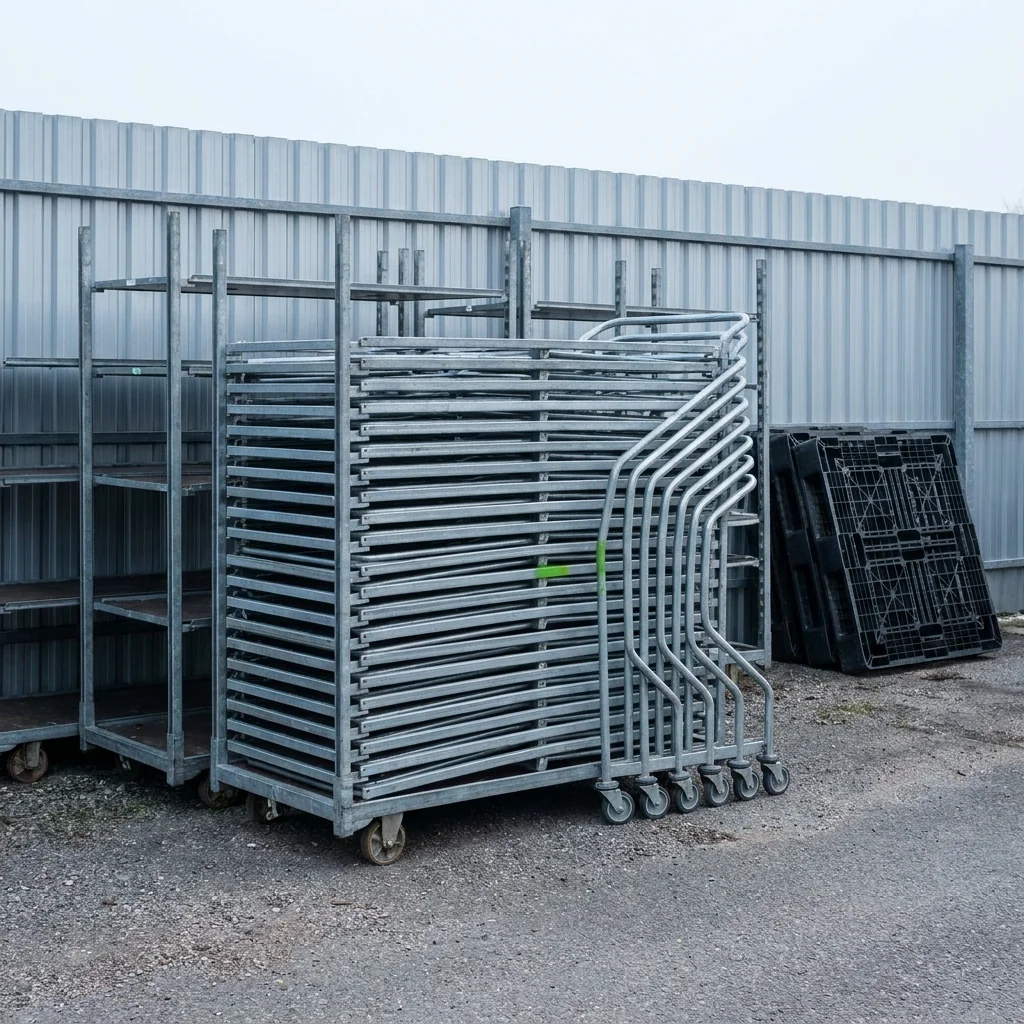
library · field guide

Half a truck to Rotterdam, every week.

A grower who fills a lorry ships cheaply. A grower who half-fills one pays for the empty space too. The oldest fix in the trade is to share the load — and the whole game is knowing, to the trolley, what went on which truck, where it was headed, and what it cost.

the economics of the empty half

Freight is priced by the truck, not by the plant.

A haulier charges for the lane and the vehicle, whether it leaves full or half-empty. So the grower with fewer plants pays more to move each one — unless the half that would have travelled empty is filled by someone else.

the small-grower penalty

Why the same plant costs more to send.

Two nurseries send identical plants to the same buyer in the Netherlands. One fills a full trailer; the other has enough for half. The full load moves at a rate per trolley that looks almost trivial. The half load carries the same trailer cost spread over half the trolleys — so every plant on it is burdened with the freight of a ghost plant that isn't there.

That is the quiet penalty a small grower pays on every under-filled run. It doesn't show up as a line on an invoice. It shows up as a thinner margin on exactly the export orders that were meant to grow the business: the long lanes, where freight is the biggest single cost after the plant itself.

The trade worked out the answer generations ago, long before anyone had software for it. You don't send half a truck. You send half a truck of yours and half a truck of someone else's, and you split the lane between you. Groupage, consolidating part-loads into one full vehicle, is how a small nursery buys freight at a big nursery's price. The idea is old. What is new is that it only pays off if the paperwork behind it is exact.
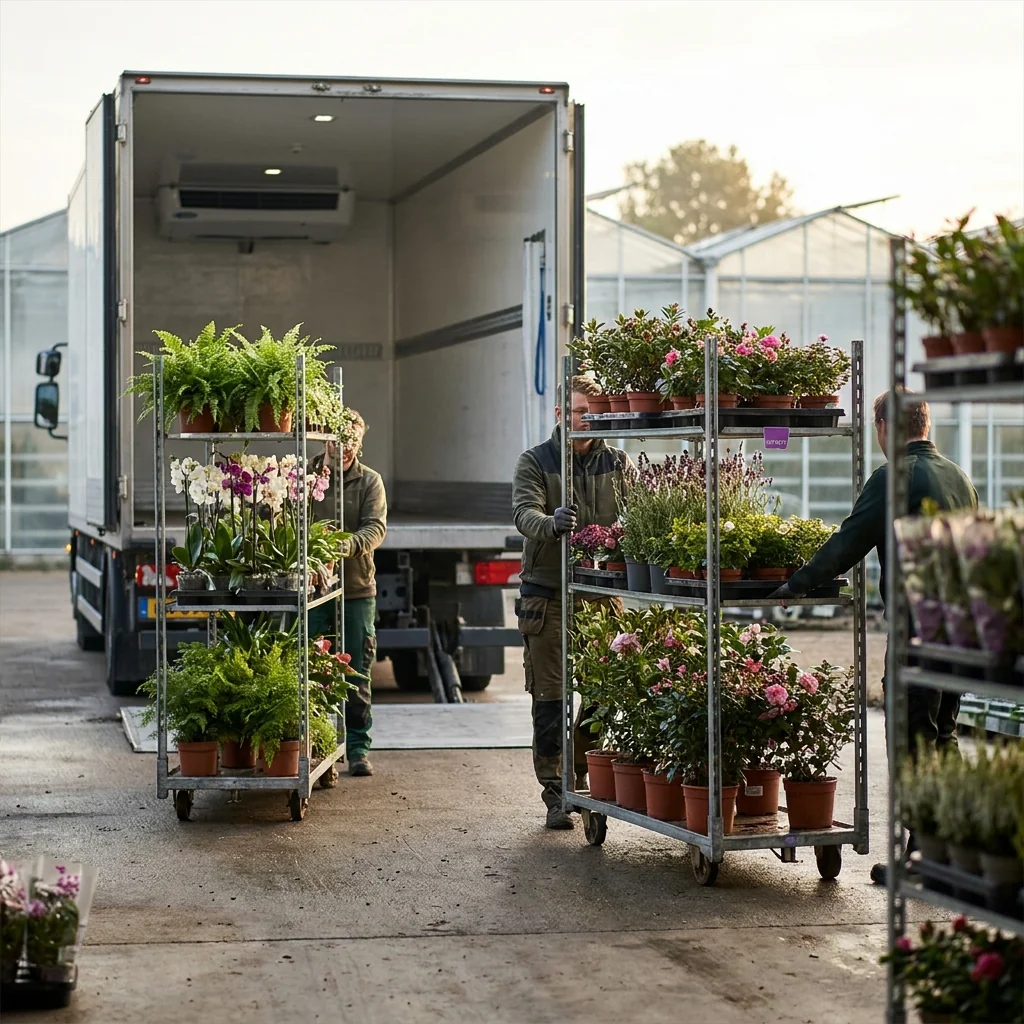

One trailer, several growers.

the shared lorry

One trailer, several growers.

Consolidation is simple to picture and unforgiving to run. Several growers with stock bound for the same region pool it onto one trailer: each contributes a handful of CC containers or Danish trolleys, the vehicle leaves full, and the lane cost is divided by who put what on board.

The saving is real and large: a part-load that would have travelled at a punishing rate per trolley now travels at the full-load rate. But it only works if three things are beyond dispute: whose trolleys are whose, where each one is going, and what share of the freight each grower owes. Get any of those wrong and the trust that holds a shared run together, often between growers who also compete, evaporates on the first disputed invoice.

The Dutch trolley is a shared language.

the trade already runs on this

The Dutch trolley is a shared language.

European horticulture already moves on a consolidation network most growers never see the full shape of. The CC (Container Centralen) trolley is a pooled, standardised unit precisely so that one grower's plants can travel next to another's without repacking. The auctions and distribution hubs around the Dutch trade exist to gather, consolidate and redistribute exactly these part-loads.

So a small grower is rarely inventing a shared run from scratch. They are plugging into an existing rhythm: the weekly lane to Rotterdam, the collection that sweeps three nurseries on the way, the hub that breaks a full inbound trailer back into regional drops. The nursery's job is to hand the network clean, countable, correctly-labelled units, and to know on its own books what it just sent and what it should be charged for it.

the real bottleneck

Consolidation is a counting problem before it is a trucking one.

The lorry is the easy part. The hard part is knowing, the moment it pulls away, exactly which trolleys, which orders, which destinations and which share of the bill left on it. A shared run lives or dies on the accuracy of that record.

Think about what a single consolidated departure actually has to answer for. It carries stock for several orders, possibly for several customers, possibly split across more than one drop. It rides on a known number of physical trolleys, each of which is an asset worth money in its own right. It travels a lane whose cost has to be apportioned back to the orders on board. And every living thing on it may need a plant passport riding alongside.

None of that is hard to record once. It becomes hard when it happens every week, at speed, on a loading dock, with the driver waiting. The nurseries that consolidate well are the ones whose system already knows, before the trailer doors close, what a "full trolley to zone 3" costs, which orders are filling this run, and how many CC containers just went out the gate that have to come back. The freight saving is only ever as reliable as that record.

Build the freight cost from its parts.

price the unit you actually ship

Build the freight cost from its parts.

A consolidated run is priced in trolleys and lanes, so the system that books it has to think that way too. A flat "delivery charge" cannot express "€X per CC container to the Randstad, €Y per pallet to the Rhineland, first six trolleys at the full-load rate." A real freight cost is built from components: a rate per unit, a rate by weight or volume, a surcharge by destination zone, each in bands, adding up to the number the haulier will actually bill.

Model it that way and the small-grower penalty becomes visible and controllable. You can see, before you commit stock to a run, whether this week's part-load clears the full-load threshold or needs one more grower's trolleys to make the rate. You quote the customer a delivery charge that reflects the consolidated price you actually pay, instead of a padded guess that loses you the order or an optimistic one that loses you the margin.

Your trolleys are worth more than one plant each.

the asset under the plants

Your trolleys are worth more than one plant each.

Every CC container and Danish trolley that leaves on a shared run is deposit money on wheels. Send out forty and get thirty-two back, and the eight that vanished into the network are a real loss — one that a busy nursery discovers months later, as a shortfall, with no idea which run swallowed them.

Consolidation makes this worse, because your equipment is now mixed with everyone else's on a pooled trailer. The only defence is to treat the container as what it is: a tracked, countable unit logged out with the load and reconciled back on return. Record the trolleys and pallets as the physical packs a delivery is actually made of, and "where did our CC containers go?" stops being an annual mystery and becomes a number you can read off the run.

atlas core

How Atlas Core supports a consolidated run

Atlas Core is built to price and record freight the way the trade actually ships it:

  • Delivery methods costed by real components: a charge built from per-unit, weight, volume, distance and postcode-zone rules, each in tiers, so "per CC container to zone 3, full-load rate over six trolleys" is a number the system works out. The calculated charge and the charge that lands on the invoice are tracked separately, with any manual override audited.
  • Ship by the trolley or the pallet. Delivery methods carry a type (loose, palletized, trolley or parcel), so a consolidated trolley run is modelled as what it is rather than forced into a parcel shape.
  • Physical packs on every delivery. A delivery breaks into the packs that actually make it up, each tied to a packaging type with its own dimensions and tare weight: the record that lets you count CC containers out and reconcile them back.
  • One order, several deliveries; several orders, one run. Partial shipments and back-orders are normal, and orders bound for the same region are consolidated into a delivery in the core, so the trailer fills from your own book first.
  • Override the method at dispatch. When a run splits or a vehicle changes, the logistics manager can change the method on the shipment itself, an audited decision that carries a reason, without rewriting what the order recorded.
  • Passports ride with the goods. Where a plant needs an EU plant passport, it prints on the delivery note in the customer's language, so a consolidated cross-border run leaves compliant.

Read further

When the courier loses your orchid Field guide · 2026

When the courier loses your orchid

A plant leaves the nursery in perfect condition and never arrives. The real cost is rarely the lost stock. It is not being able to say which courier had it, which parcel it was in, or where its trail went cold. How to make a missing order a lookup, not a shrug.

7 min read · Jul 2026 Read →
The right VAT in seven countries Field guide · 2026

The right VAT in seven countries

A pallet that crosses two borders can carry three different tax answers before it is paid for. Who charges VAT, who reclaims it and who simply reports it depends on the buyer, the border and where the goods end up - and the reason a line is zero matters more than the rate.

7 min read · Jul 2026 Read →
Where is a plant actually from? Field guide · 2026

Where is a plant actually from?

Every plant passport carries a country of origin - the deceptively simple Field D. For a plant propagated in one country and grown on in another, that single answer is rarely obvious. Why growers guess, and the mislabelling that follows.

7 min read · Jul 2026 Read →

Ship the small load at the big load's rate.

Atlas Core prices freight by the trolley and the zone, records the packs a run is really made of, and consolidates your orders into full departures — so the half-empty trailer stops eating your margin. Talk to us about how it fits your nursery.