library · field guide

EU plant passports, end-to-end.

A small official label travels with plants for planting as they move between professional operators across the EU. Get the underlying records right and issuing one is routine; get them wrong and it is the first thing an inspector notices. Here is the whole journey, from breeding stock to retail label.

what it really is

A passport is a claim, written small.

Four fields on a sticker no bigger than a luggage tag. But each field is a statement you are legally accountable for — and the label is only ever as honest as the records standing behind it.

the document, defined

What a plant passport actually covers.

A plant passport is an official label required for plants for planting, and certain other regulated goods, when they are moved between professional operators within the EU — and in some cases when they are sold to a final user. It travels attached to the plant, the batch or its packaging, and it says, in a standard form, that the goods meet the EU's plant-health requirements.

The legal foundation is Regulation (EU) 2016/2031, the EU plant health law, with the passport's exact format laid down by Commission Implementing Regulation (EU) 2017/2313. That is why a passport from a Dutch nursery and one from a Romanian grower look the same: the layout is harmonised across the Union.

It helps to be clear about what a passport is not. A phytosanitary certificate is a separate document, for moving plants across the EU's external border, into or out of the Union. A passport governs movement inside the single market between businesses; a phytosanitary certificate governs import and export. Confusing the two is one of the most common compliance mistakes, and one of the most avoidable.

A, B, C, D — and never without the flag.

the four elements

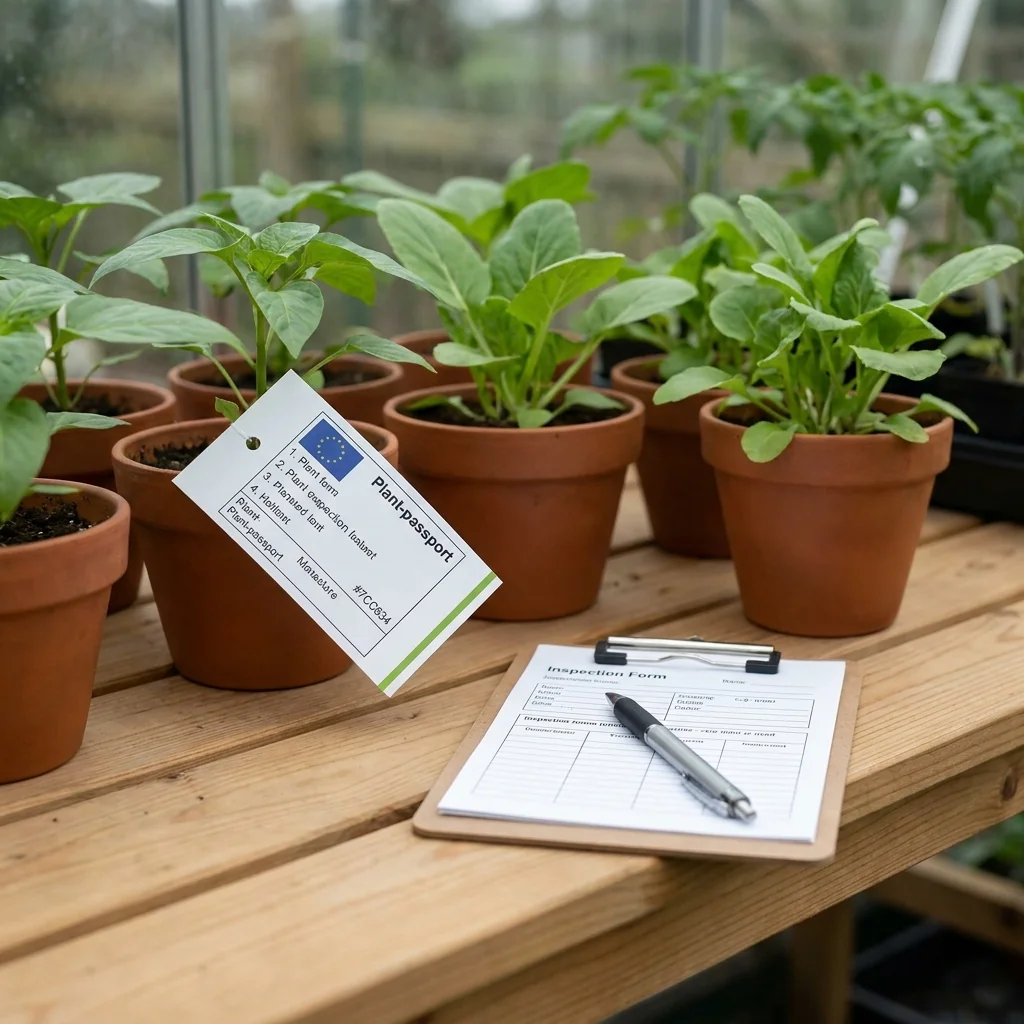
A, B, C, D — and never without the flag.

Every passport carries the EU flag in the top-left corner and the words "Plant Passport" in the top-right. Below them sit four mandatory elements, each labelled by letter:

  • A — Botanical name. The genus, or genus and species, of the plant.
  • B — Operator registration. The two-letter country code plus the issuing operator's registration number, for example NL-12345.
  • C — Traceability code. The batch or lot reference, which may be reinforced by a barcode, QR code or hologram.
  • D — Country of origin. The two-letter code for where the plant was grown.

A passport that crosses into a protected zone reads "Plant Passport — PZ" and certifies stricter freedom from a specific regulated pest that the zone is kept clear of.

Registered, then authorised.

who issues them

Registered, then authorised.

Passports are issued by professional operators: nurseries, growers, traders. The authorities do not issue them directly, and the right to issue is earned in two steps.

First you must be registered with your National Plant Protection Organisation (NPPO). Then, to actually issue passports, you must be authorised to do so for the plants you handle. Authorisation rests on a simple expectation: that you know your stock, monitor its health, and can prove its provenance on demand.

That is the quiet pivot of the whole regime. The authority is not signing off each label. You are. The passport carries your registration number because the accountability is yours, which is why the records behind it have to be in order before the inspector arrives.

traceability

One step back, one step forward.

The obligation is narrow: know exactly where a batch came from, exactly where it went, and be able to show both. Done consistently, those two links chain into a complete history.

The traceability obligation is deliberately modest in scope and unforgiving in practice. For every batch you handle, you must be able to trace one step back to the operator who supplied it, and one step forward to the operator you supplied it to. You keep the records that prove both, commonly for three years.

It sounds light, and per-transaction it is. The difficulty is cumulative: a nursery handling thousands of batches a season is maintaining thousands of these back-and-forward links at once, each one needing a botanical name, an origin, a batch code and a date that all agree with the label you actually printed. Reconstruct that from memory and a drawer of delivery notes and it is a bad afternoon. Pull it from a stock system that recorded each movement as it happened and it is a query.

Protected-zone consignments raise the bar again: there you are certifying freedom from a named pest, so the underlying inspection and testing history has to support the stricter PZ claim.

the journey, in one view

Breeding stock to retail label — the end-to-end checklist.

Walk a plant from the mother holding to the shelf and the passport is the last, smallest step — possible only because every earlier step was recorded:

  • Register and get authorised with your NPPO for the plants you handle, before you issue anything.
  • Capture provenance at intake. Botanical name, source operator and country of origin, so elements A and D are never guesswork later.
  • Assign a traceable batch code to each lot and keep it attached through every split, pot-on and move; that code becomes element C.
  • Log health as you go. Inspections, tests, treatments and certifications, so a standard or a PZ claim is always defensible.
  • Record one step back and one step forward for every movement, and keep those records, commonly three years.
  • Print the passport from the record, with the EU flag, "Plant Passport", and A/B/C/D drawn straight from the data you already hold.

Do this and the passport stops being a moment of anxiety at dispatch. It becomes a by-product of running an orderly nursery, where the provenance, the batch lineage and the health history are already recorded and issuing a correct, audit-ready passport is a query.

atlas core

How Atlas Core handles EU plant passports

Atlas Core turns the passport into a by-product of the records you already keep:

  • Captures provenance at intake. Botanical name, source operator and country of origin, so passport elements A and D are drawn straight from recorded data rather than reconstructed from memory.
  • Maintains batch lineage through every split, pot-on and move, so the traceability code (element C) stays attached to the plant and the one-step-back / one-step-forward links are always intact.
  • Logs inspection, testing and treatment history against each batch, so a standard or stricter protected-zone (PZ) claim is always defensible on demand.
  • Prints a correctly formatted passport with the EU flag, "Plant Passport" and A/B/C/D, directly from the underlying record, so the label and the data can never disagree.
  • Retains the movement records (commonly three years) in one queryable place, turning an inspector's request from a scramble through delivery notes into a single lookup.

Read further

Make the passport the easy part.

Atlas Core keeps provenance, batch lineage and health records in one place, so every passport you print is drawn from the truth and ready for an inspector. Talk to us about how it fits your operation.