library · tech brief

Where does your data actually live?

"The cloud" gets used as if it were weather — vague, everywhere and slightly suspect. But your business records live somewhere real and specific, and where that is changes a great deal about how safe, how reachable and how much trouble they are. Here is the plain-English version, with the jargon left at the door.

the plain version

The cloud is just someone else's computer, run properly.

There is no cloud. There are professionally run servers in secure buildings, maintained by people whose entire job is to keep them safe, powered and online. "Cloud" is simply the word for letting them do that instead of doing it yourself.

the question worth asking

Two places your data could live.

Strip away the marketing and every business system stores its data in one of two kinds of place. The first is a machine you own and mind: the tower under the office desk, the laptop in the manager's bag, the old server humming in a cupboard. It is yours, it is in the building, and everything that happens to that building happens to it: the power cuts, the heat, the dust, the theft, the day nobody remembered to back it up.

The second is a managed server, a professionally run computer in a purpose-built data centre, looked after by a team whose only job is keeping it powered, cooled, secured and online. You never see it and never have to think about it. This is what people mean, underneath all the vagueness, when they say "the cloud."

Cloud-hosted business software lives firmly in the second place: your records sit on managed infrastructure, not on a machine in your office. The grower gets a system reached through a browser; the hard, unglamorous work of running the computer behind it is simply someone else's problem now.
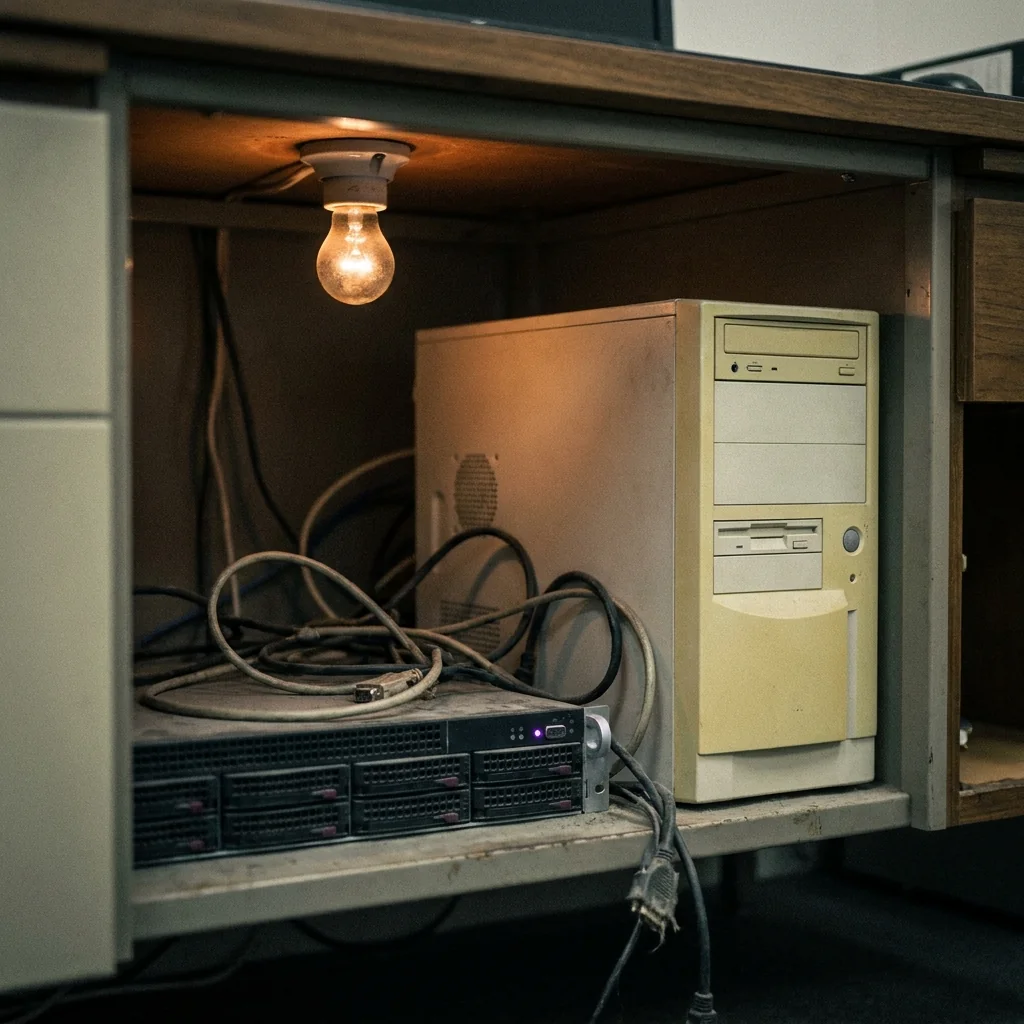

Nobody at the nursery should be a sysadmin.

managed, not minded

Nobody at the nursery should be a sysadmin.

Running your own server is a real job, and a thankless one. Someone has to apply the security patches, watch the disk filling up, replace the drive that is about to fail, keep the backups running and be there at 2am when it isn't. In a nursery, that someone is usually nobody — until it suddenly, expensively, has to be.

Managed hosting takes that whole burden off the business. The patching, the monitoring, the hardware, the uptime — all handled by people who do nothing else, around the clock. You grow plants; they run the servers. The expertise that used to mean hiring an IT person, or hoping the owner's nephew is free this weekend, is simply built into the service.

Your office is wherever you open a browser.

reachable from anywhere

Your office is wherever you open a browser.

When the system lives on a machine in the office, you have to be at that machine to use it. Want the stock figure while you are standing in the polytunnel? Walk back to the desk. Need a price on the road, at a trade show, at a customer's gate? You can't.

Because a cloud system runs on a managed server rather than a machine in the office, it is reachable from any device with a browser: the office desktop, a laptop at home, a tablet in the glasshouse, a phone at a fair. The same live data, wherever you happen to be standing.

what actually changes

You notice it by what stops happening.

You don't watch the servers or admire the data centre. What you notice is everything you no longer have to do, and everything you can suddenly do from anywhere.

The move to the cloud doesn't announce itself. There is no new box to admire, no cupboard to fill. What changes is quieter and better: the things that used to be your problem stop being your problem. You are not the one buying a server every few years, nor the one explaining why the system is down because the office lost power.

In their place comes a kind of freedom that is easy to underrate until you have it. The system is there from wherever the work takes you, on whatever device is to hand, and it is looked after by people doing nothing else. The cloud, stripped of its mystique, is mostly an absence of jobs you should never have had to do in the first place.

No discs, no upgrades, no version you're stuck on.

always the latest

No discs, no upgrades, no version you're stuck on.

Software you install on your own machine freezes in time the day you install it. To get the next version you buy it, schedule the downtime, and hope the upgrade goes cleanly — so most businesses simply don't, and limp along on a release that is years out of date.

Cloud-hosted software doesn't work that way. Improvements, fixes and new features arrive centrally, applied to the managed system for everyone at once, with nothing for you to install. You open the browser tomorrow and it is simply better than it was today. There is no "version you're on" to fall behind, and no upgrade day to dread.

Off your premises, and better for it.

a real place, a safe one

Off your premises, and better for it.

It can feel counter-intuitive that your data is safer somewhere you cannot see it than locked in your own office. But a data centre is built for exactly one purpose, to a standard no nursery office could match: redundant power so an outage doesn't stop it, climate control so nothing overheats, physical security, fire suppression, and round-the-clock monitoring.

None of that dilutes your ownership. The records are still yours; they are simply housed in a building designed to keep them. Off the premises does not mean out of your hands. It means kept somewhere far better at keeping it than a cupboard behind the till ever could be.

atlas core

How Atlas Core handles where your data lives

Atlas Core puts the principles above into practice for horticultural management:

  • Fully cloud-hosted on managed infrastructure. Your nursery's records live on professionally run servers in a purpose-built data centre, never on a tower under the office desk that can be stolen, flooded or left un-backed-up.
  • Reached from any device with a browser. Check stock from the polytunnel, quote a price at a trade show, review orders from the kitchen table, all against the same live data.
  • Zero maintenance for the grower. Patching, monitoring, backups, hardware replacement and uptime are all handled full-time, so nobody at the nursery ever has to be the sysadmin.
  • Always the current version. Improvements and fixes arrive centrally with nothing to install, so there is no upgrade day to schedule and no out-of-date release to limp along on.
  • A building built for the job. Redundant power, climate control, physical security and fire suppression protect your instance to a standard no nursery office could match, so off-premises never means out of your hands.

Read further

Put your nursery somewhere built to keep it.

Cloud-hosted, professionally managed, reachable from any device and always up to date. Atlas Core gives your records a proper home, so you never have to run a server to run a nursery. Talk to us about how it works.