library · field guide

The queue is your worst salesperson.

Everything else in the garden centre is designed to make people want plants. The queue is the one part of the visit that talks them back out of it — and on the days that matter most, it does the most talking.

the last ten minutes

Nobody ever bought more because the wait was longer.

Every other part of the visit can add to the basket. The counter can only ever subtract from it — which makes it the one place where speed is worth real money.

saturday economics

A year of trading, squeezed into about forty afternoons.

Garden retail is a handful of enormous days wrapped in a lot of quiet ones. A warm spring Saturday can do many times an ordinary Tuesday, and the whole of it lands between roughly eleven and three.

For a few hours a week the counter is the actual bottleneck of the entire enterprise, the single point every customer must pass through at exactly the moment there are most of them. The rest of the year it comfortably keeps up, which is precisely why it never gets looked at. Nobody redesigns a process that works fine for eighty per cent of the calendar and quietly falls apart during the twenty per cent that pays for everything.

And the cost of it falling apart doesn't appear in any report. There is no line called sales we didn't make because the queue reached the tomatoes. The trolley just gets pushed against a bench, and the customer walks out — and the only thing the books record is a slightly disappointing Saturday.

People will queue for a phone. They will not queue for a shrub.

the abandoned trolley

People will queue for a phone. They will not queue for a shrub.

Plant buying is largely unplanned. Somebody came for compost, filled a trolley because the pelargoniums looked good, and is now holding forty euros of things they did not set out to buy. That is a wonderful position for a retailer — and an extremely fragile one.

Impulse doesn't survive a wait. Give a customer ten minutes in a queue with a trolley of things they didn't come for, and they will start justifying the trip out of existence. The bigger the basket, the more likely it is to be reconsidered, which means the queue costs you most on exactly the baskets you most want.

Then there is the physical problem no other retailer has: the trolley itself. A garden trolley is enormous, awkward and often carrying wet, loose, unbarcoded stock. Abandoning one is easy. Getting it through a slow counter is not.

Speed is fewer decisions, not faster fingers.

what fast actually is

Speed is fewer decisions, not faster fingers.

Ask why a counter is slow and you will be told the staff are busy. Watch it for an hour and you will see something else: the till keeps asking questions nobody at the counter should be answering on a Saturday.

The seconds go on lookups. An unlabelled plant, a faded barcode, a tray priced by the unit when the customer has taken six. A member number that has to be typed. A screen that needs four taps for a thing done two hundred times a day. Each is trivial. Multiplied by a full counter, they are the queue.

A fast till is a till that already knows. Priced-by-weight and priced-by-unit handled without a decision, loyalty found by a card rather than a conversation, the twenty most-sold lines a single tap away, and a screen an ordinary seasonal hire can use confidently in their first hour, because in April half your counter staff started last week.

the other failure

A slow till costs you a basket. A stopped one costs you the day.

The counter is the only part of a garden centre with no manual fallback worth having — and it is usually the part most dependent on something outside the building.

Every garden centre has the story. The line went down at half past twelve on the best Saturday of May. For forty minutes there was a pad of paper, a queue out of the door, and a manager doing sums in their head while several hundred euros of plants walked back to the benches.

It is worth being precise about why this happens here more than elsewhere. Garden centres are frequently rural, on the end of poor connectivity, in buildings made largely of glass and steel. Peak trade lands on the days when everything is loaded hardest. The result is that the single most valuable hour of the year is riding on the least reliable infrastructure on the site.

The answer is a counter that degrades gracefully: one that keeps ringing up sales when the connection drops and reconciles when it returns, rather than one that simply stops and takes the day with it. A till that works offline is the difference between a bad hour and a lost Saturday.

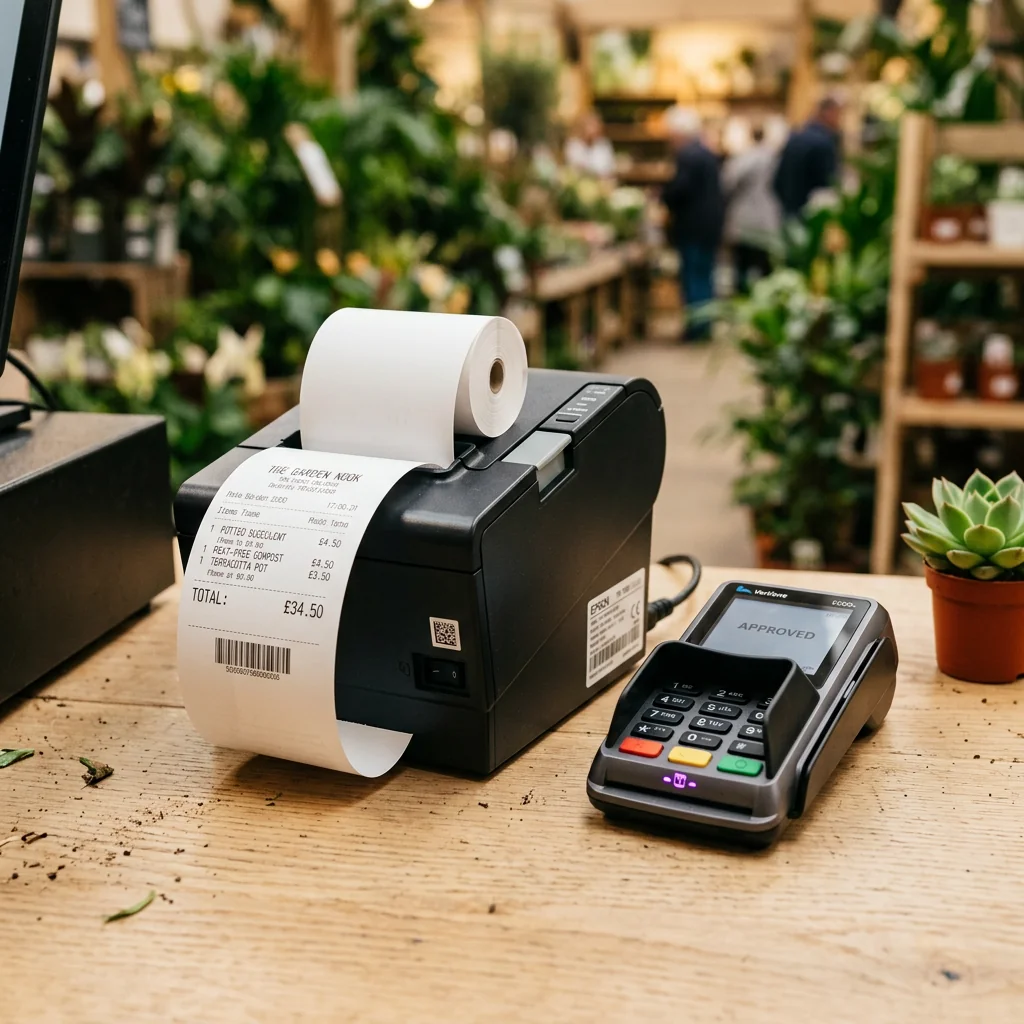
The receipt still has to print.

keep selling anyway

The receipt still has to print.

Graceful degradation sounds abstract until you list what actually has to keep working when the connection goes: ring up a basket, take a card, print a receipt, and remember all of it faithfully so the books balance later.

That is a deliberately small list, and that is the point. A counter should be built around the handful of things it must never fail to do, with everything clever kept safely to one side of that line. Reporting, stock enquiries and clever pricing rules can wait five minutes. Taking money cannot.

The same logic applies to the boring hardware nobody thinks about until it matters — the printer, the drawer, the card terminal, the scanner. On a peak Saturday, a till that stops for any reason at all is indistinguishable from a till that was never there.

Fast enough that somebody can still say something useful.

the last conversation

Fast enough that somebody can still say something useful.

There is a version of this argument that ends with self-service kiosks and no human at all, and for a garden centre that is the wrong answer. The counter is the final chance to say water that one properly for the first fortnight — the sentence that decides whether the plant lives, and whether the customer comes back at all.

Advice is what the trade genuinely has over a supermarket and a website. But nobody gives advice while fighting a screen. It is the first thing to go when the counter is under pressure, and it goes silently.

So the real case for speed is attention. Efficiency at the till clears the queue, keeps the impulse basket intact, and leaves the person behind the counter enough head-room to be the reason somebody chose a garden centre in the first place.

atlas core

How Atlas Core handles the counter

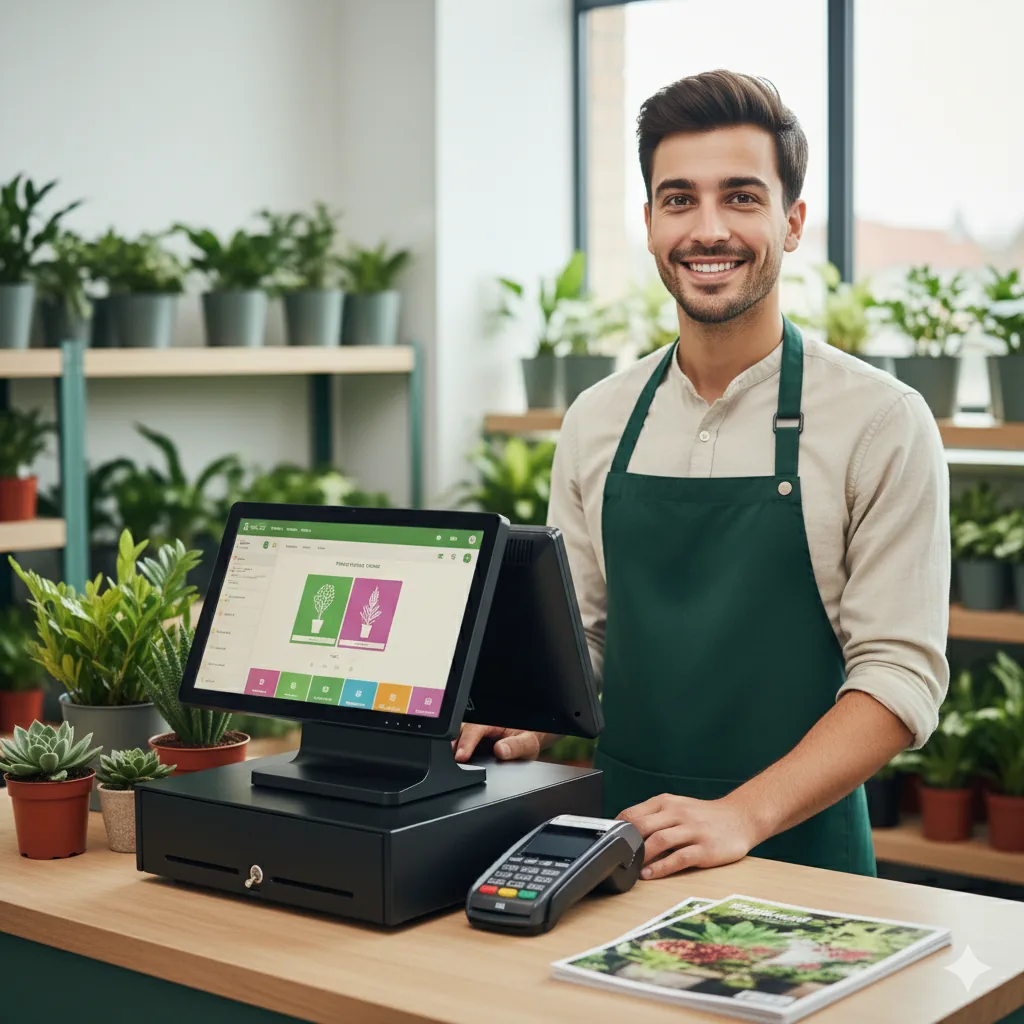
Selling at a counter is a different job from running a nursery, so Atlas Core doesn't try to do it on one screen. The till is its own app, Atlas Cassa, working against Atlas Core as the system of record:

  • A separate, deliberately simple point-of-sale app. Cassa is built for speed at the counter and nothing else. The back-office weight stays in Atlas Core, where it belongs, instead of slowing down a queue.
  • Sales push straight into Atlas Core. Cassa records the Sale and pushes it through; the customer walks away with the till receipt Cassa printed, while Atlas Core keeps the matching invoice internally for your accounts and tax. The customer never has to see it.
  • A Sale behaves like a Sale, not a shrunken order. Placed, paid and taken away in one step, locked once confirmed, with stock settled in a single movement at the moment of sale rather than reserved and allocated ahead of time, which is what keeps the transaction short.
  • Every till is a Terminal, an authenticated device that issues retail sales, with a Terminal Report rolling up that till's sales, units and revenue at the end of each day.
  • Counter returns happen at the counter, handled in Cassa rather than raised as Credit Notes in Atlas Core, while the policies governing them, such as restocking rules, stay defined centrally in Atlas Core.

Read further

A plant remembers a cold lorry Field guide · 2026

A plant remembers a cold lorry

Plants never complain on arrival. They look fine at the gate, then bronze, drop leaves and stall three weeks later on someone else's bench - and the claim comes back to you, long after the lorry has been forgotten.

8 min read · Aug 2026 Read →
Last year's plan, again Field guide · 2026

Last year's plan, again

Every nursery forecasts. The only question is whether it does so on purpose - because sowing the same number as last year is a prediction too, made silently, by nobody, and never checked afterwards.

8 min read · Aug 2026 Read →

Get the queue out of the way.

Atlas Cassa at the counter, Atlas Core behind it — see how it fits your garden centre.