library · tech brief

The hidden cost of a dozen tools.

Most nurseries never decided to run on a dozen disconnected tools — it accreted, one spreadsheet and one app at a time. Each looked free. The bill arrives later, paid in rekeyed data, hours spent reconciling, and decisions made on numbers nobody fully trusts.

the real problem

The cost is in the gaps between the tools.

No single spreadsheet is the problem. The problem is the seams — every place where data has to leave one tool and be retyped into the next, and every moment two of them quietly disagree.

how it happens

Nobody chooses fragmentation. It accumulates.

It starts sensibly. Stock lives in a spreadsheet because a spreadsheet is fast and everyone knows it. Orders come in by email and phone, so they go in a second spreadsheet. The webshop has its own admin panel. Deliveries get arranged in a WhatsApp group with the drivers. Invoices are run off in the accounts package. Prices for the trade sit in a shared doc. Each tool was the obvious answer to the problem in front of someone, on the day they reached for it.

None of them is wrong on its own. The trouble is that a nursery is one business, and these tools each believe they are the whole story. The webshop doesn't know what the wholesale side just sold. The stock sheet doesn't know what's reserved against a quote. The accounts package doesn't know a delivery bounced. Every tool holds a sliver of the truth and none holds all of it.

So someone has to be the glue. A person becomes the integration layer — copying numbers from one screen to another, chasing the version everyone should be using, and holding in their head the parts no system records. That work is invisible until they take a holiday.


The day two files disagree.

the reconciliation tax

The day two files disagree.

Fragmentation stays cheap right up until two tools say different things — and then it is expensive all at once. The stock sheet says forty; the webshop sold thirty-eight; the bench has thirty-one because some graded down and a tray was dropped. Which number is real?

Answering that is the reconciliation tax: the recurring hours spent not running the business but proving which of your own records to believe. It is paid every month-end, every stock-take, every time a customer is promised something that isn't there. And it compounds — the longer two tools drift apart, the harder it is to ever reconcile them, until the honest answer becomes "we're not sure", and you start ordering and selling around a number you already know is wrong.

Typing the same order four times.

the swivel-chair tax

Typing the same order four times.

The other steady drain is re-entry. The same order is keyed once into the order sheet, again to raise an invoice, again to tell the driver, again to adjust stock. Each retype takes minutes and invites a typo — and a typo in a quantity or a price is a real plant or a real euro gone astray.

This is sometimes called the swivel-chair workflow: a human swivelling between screens, acting as the wire the systems don't have. It scales badly. Double the orders and you double the typing and the typos, and double the chance that one of the four copies never gets the correction the other three received.

the alternative

One record, read by everything.

An integrated system removes the seams rather than papering over them. The catalogue, stock, orders, money and delivery become one record that every part of the business reads and writes.

"Integrated" is an overused word, so it is worth being precise. It does not mean a dozen tools with cables run between them, hoping each export lands in the right import. That is just fragmentation with extra moving parts to break.

It means there is one source of truth. When a sale is made, stock falls, because the sale and the stock are the same database. When a quote is accepted it becomes an order, carrying its lines and prices with it, with nothing retyped. When that order ships, the invoice and the stock movement already know. The order, the money and the delivery are different views of one fact. The reconciliation tax falls to near zero because there is nothing to reconcile: there was only ever one number.

One core, apps that feed it.

specialised, not separate

One core, apps that feed it.

Integration doesn't mean one giant screen that does everything badly. Some jobs genuinely deserve a dedicated tool — a till has to be fast at the counter, a customer portal has to live on the open web. The question is whether those tools share the core's truth or keep their own.

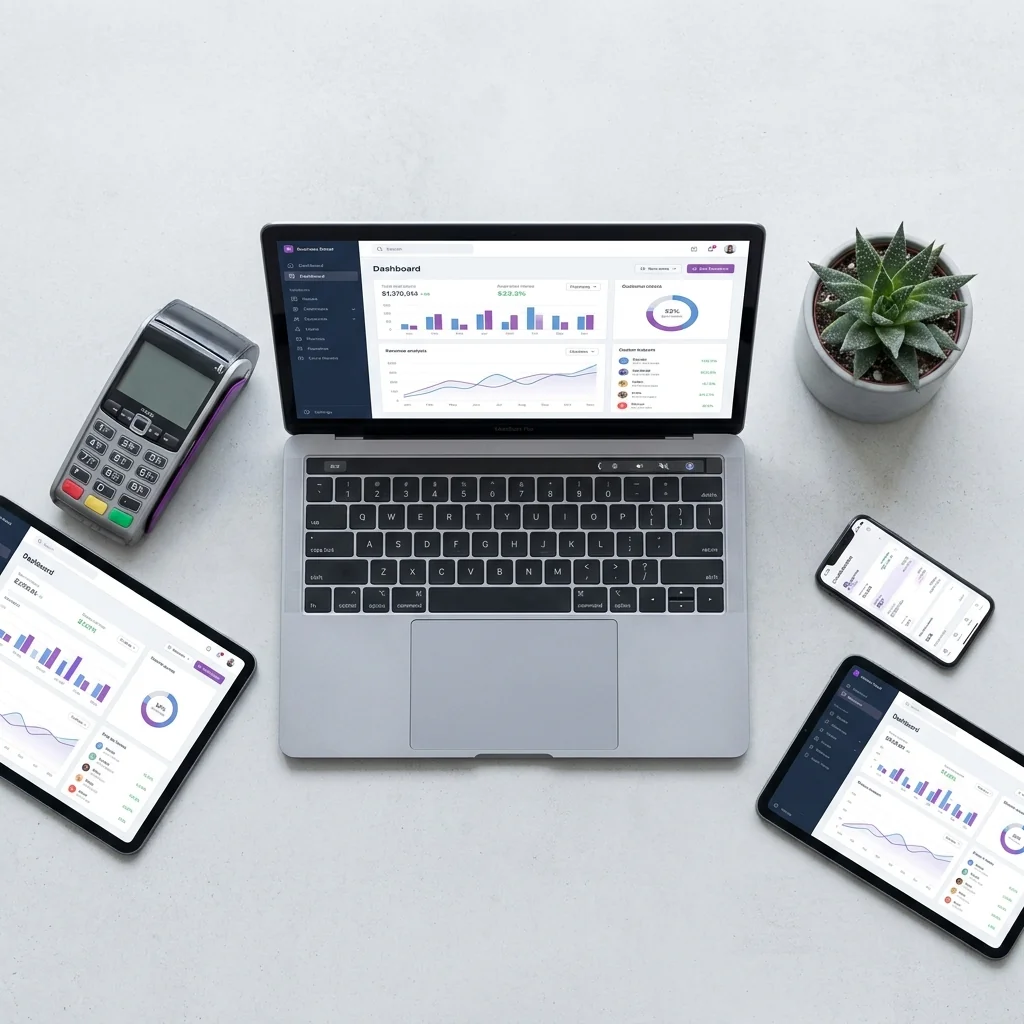
In this model a single back office holds the catalogue, stock, customers and money, and specialised apps connect straight back to it rather than keeping their own copy. A fast counter till pushes each shop sale into that core; a customer-facing web portal creates real orders inside it; help and reporting read from the same records. Each app specialises in its job without forking the data — so a sale at the counter and an order from the website land in the same place, counted once.

You only see the parts you use.

without the bloat

You only see the parts you use.

The usual objection to one system is that it becomes a bloated monolith — every feature for every kind of business, most of it irrelevant. That is a real failure mode, and it is avoidable. The fix is one system that shows each business only the parts that fit it.

A grower sees propagation and production; a retail shop sees the till and never the growing screens. The single record stays whole underneath, but the surface is shaped to the work. Consolidation should remove clutter rather than add it.

atlas core

How Atlas Core handles the single-source-of-truth problem

Atlas Core is one implementation of the pattern above — built for horticulture, not bolted onto a generic ERP.

  • One shared record for catalogue, stock, orders, invoicing and delivery — a sale drops stock instantly because they are the same database, so the reconciliation tax falls to near zero.
  • Quote to order to invoice with nothing retyped — an accepted quote becomes an order carrying its own lines and prices, and the invoice and stock movement already know when it ships, killing the swivel-chair re-entry.
  • Companion apps feed the same core — the Atlas Cassa counter till and the B2B trade portal push sales and orders straight into one back office, so a shop sale and a webshop order are counted once.
  • Role-shaped views keep it lean — growers see propagation and production, retail sees the till and never the growing screens, so consolidation removes clutter instead of becoming a bloated monolith.

Read further

Switch systems without losing five years Tech brief · 2026

Switch systems without losing five years

The biggest reason nurseries stay on software they've outgrown is the fear of starting over. It's also the most avoidable. How your catalogue, customers, stock and history move across by spreadsheet, in a checked migration rather than a leap of faith.

7 min read · Jun 2026 Read →
That webshop order might be illegal Field guide · 2026

That webshop order might be illegal

Hand a plant across the counter and it needs no passport; post it from your webshop and the law changes. Distance sales pull retail under the plant-passport rule - the carve-out that catches any nursery adding a 'buy online' button.

7 min read · Jun 2026 Read →
A tree and a pot, same database? Tech brief · 2026

A tree and a pot, same database?

A living field-grown tree and an inert plastic pot share a price list yet share almost no attributes. Why rigid product databases fail horticulture, and how a two-level catalogue lets each line be exactly what it is.

6 min read · Jun 2026 Read →

See your whole nursery on one record.

Atlas Core brings the catalogue, stock, orders, invoicing and delivery into a single system built for horticulture — with companion apps that feed the same core instead of forking it. Talk to us about replacing the dozen tools with one.